Bio6 provides researchers with standardised tools for capturing movement data, running clinical studies, and exporting FHIR-compliant datasets.
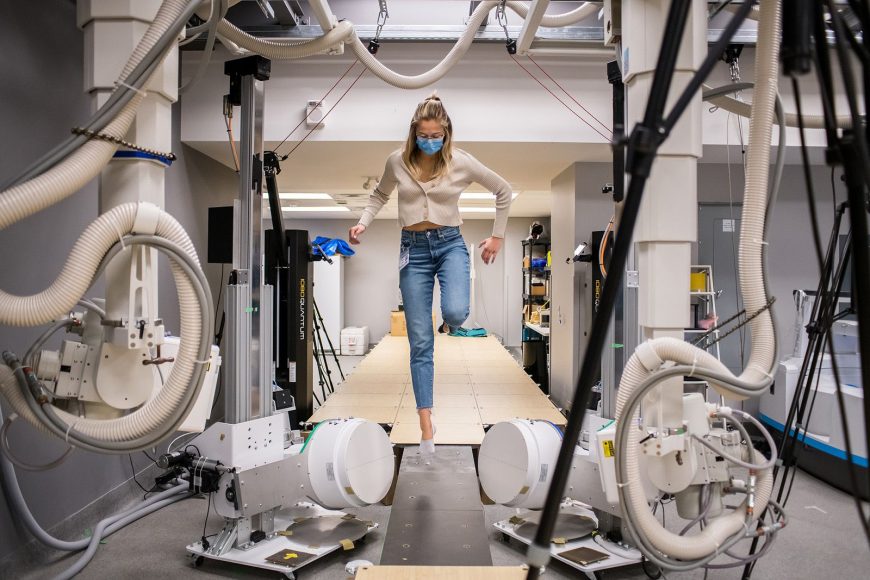
Researchers studying human movement often rely on laboratory equipment that is expensive, complex, and difficult to deploy outside specialised environments. Collecting biomechanical data in real-world clinical settings can be challenging.
Bio6 provides a wearable sensing platform that allows researchers to capture movement data during functional tasks and rehabilitation exercises — in clinics, rehabilitation centres, and real-world environments.
Capture objective movement data
Replace laboratory motion capture equipment with wearable sensors that measure joint kinematics, symmetry, and biomechanical patterns during functional tasks.
Track longitudinal recovery
Collect data across multiple time points and sessions to study recovery trajectories, treatment response, and the effectiveness of rehabilitation protocols over time.
Analyse neuromuscular function
Measure muscle activation timing and neuromuscular coordination during movement assessments to study motor control in clinical and healthy populations.
Deploy in real-world environments
Conduct research studies outside the laboratory in clinics, rehabilitation centres, and community settings to improve ecological validity of findings.
Researchers studying stroke rehabilitation aim to understand how patients regain walking symmetry during recovery. Using BioBand sensors, researchers capture walking data during therapy sessions to quantify recovery progression and evaluate rehabilitation protocol effectiveness.
Measurements captured
BioBand sensors capture the following signals during walking assessments across sessions:
Stride symmetry index
Session 1
63%
Session 8
82%
Stride symmetry index — 8 sessions
Research insight
Stride symmetry improved from 63% to 82% over 8 sessions, reflecting progressive gait normalisation post-stroke.
From protocol design to publication-ready datasets — Bio6 supports every stage of the research process.
Define movement tests and rehabilitation tasks that align with the research objectives and study design.
Participants perform movement tasks while wearing BioBand sensors, capturing biomechanical and physiological signals in real time.
Visualise movement patterns, biomechanical metrics, and neuromuscular signals using the Bio6 research dashboard.
Export structured data in standardised formats for statistical analysis, modelling, and inclusion in scientific publications.
Define movement tests and rehabilitation tasks that align with the research objectives and study design.
Participants perform movement tasks while wearing BioBand sensors, capturing biomechanical and physiological signals in real time.
Visualise movement patterns, biomechanical metrics, and neuromuscular signals using the Bio6 research dashboard.
Export structured data in standardised formats for statistical analysis, modelling, and inclusion in scientific publications.
Bio6 generates structured datasets and visualisations that help researchers analyse movement patterns and rehabilitation outcomes.
Movement Symmetry — Session 1
64%
Movement Symmetry — Session 6
86%
Movement Symmetry — 6 sessions
Research finding
Significant improvement in stride symmetry across all 6 sessions, indicating progressive gait normalisation.
Bio6 gives researchers the metrics and structured datasets they need to analyse movement patterns, evaluate rehabilitation outcomes, and publish scientific findings.
Collect biomechanical data across study sessions and time points. Monitor recovery trajectories and compare participant datasets to establish normative benchmarks and study treatment effectiveness.
Measure left-right balance and bilateral coordination during functional movement tasks. Quantify symmetry indices across study populations to study neuromuscular control and asymmetry patterns.
Track participants against standardised functional benchmarks. Generate consistent outcome scores across sessions to support statistical analysis and comparison between intervention and control groups.
Generate publication-ready datasets and visualisations. Export biomechanical metrics, neuromuscular signals, and physiological data in structured formats ready for statistical analysis and scientific reporting.

Patients follow their rehabilitation programs, log symptoms, and track their own progress through a connected mobile app — with guided programs, progress tracking, symptom logging, and increased adherence.
Discover Patient AppMove from subjective observation to measurable, data-driven care. Bio6 helps clinicians deliver better outcomes with less friction.
WHAT IT INCLUDES

Manage patients, document sessions, and organize your workflow with tools built for rehabilitation teams.
Explore Clinical Operations →
Build programs, guide sessions, and track adherence to ensure patients stay engaged and progress between visits.
Explore Clinical Care →
Analyze movement, detect asymmetries, and track recovery to support faster, more confident clinical decisions.
Explore Clinical Intelligence →